The country that gave me a window
A teenage bedroom, a tax reform, and the window a country opened.
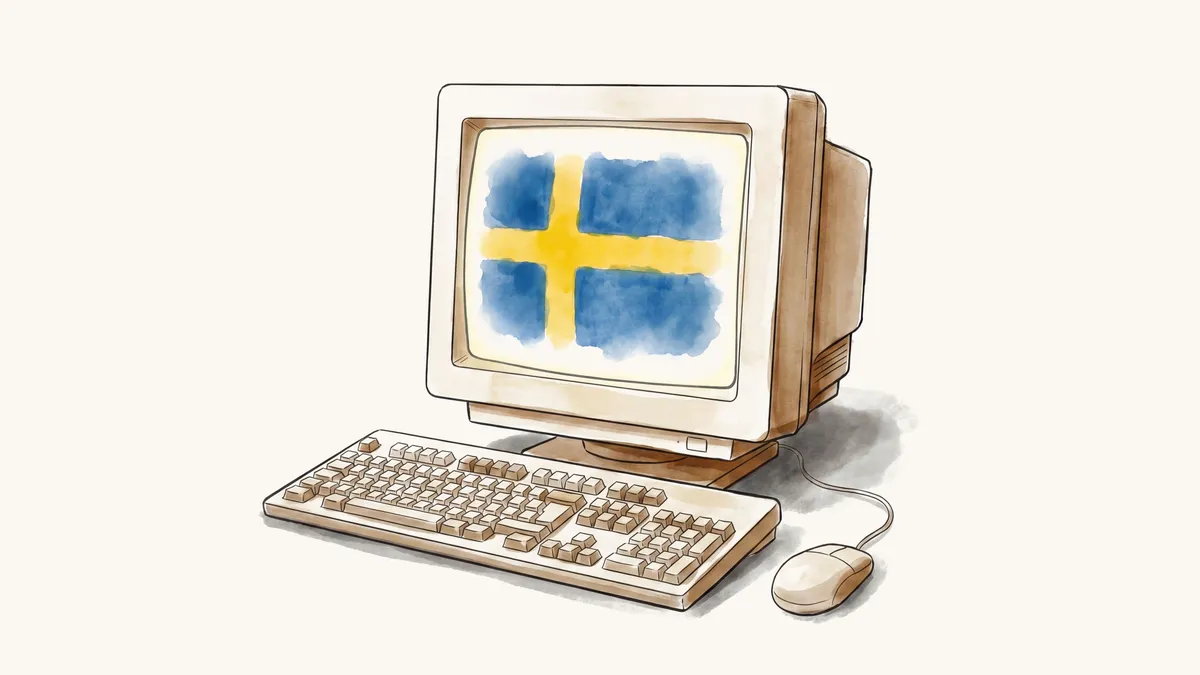
It’s 1998. I’m in my bedroom in a village in the north of Sweden, and the Pentium II 450 on the desk is busy.
Notepad in one window. ICQ pinging in another. Eagle-Eye Cherry’s Save Tonight looping in the background. Below the desk, a modem holding the phone line open. A handful of friends online, most of them in Lulea, fifty kilometres south.
A year ago none of this was here. At least not for me.
We had one PC in the house. A Pentium 166 MMX, worth a small fortune, that my parents had bought out-of-pocket in 1997. Tomb Raider 1 went into the CD-ROM drive and Lara Croft was running around on screen. Save Tonight was the first MP3 I ever owned.
I had never had anything like it. Life was good!
By the time my parents bought a second one six months later, Sweden had decided that everyone should be able to afford a computer.
The mechanism was a tax exemption. Employers provided the computer; the cost came out of the employee’s gross salary, before income tax was applied.
The discount was the employee’s marginal tax rate. Somewhere between a third and a half off, depending on what you earned. Eight hundred and fifty thousand of them moved in the first few years, into a country of nine million.
One of them was a Pentium II 450 with a separate GPU, and it went into my bedroom. A dream machine. The second small fortune my parents had spent on us in less than a year. I didn’t understand the sacrifice at the time.
The Swedes had a name for it. Hem-PC-reformen. The home-PC reform.
It changed things faster than anyone would have thought.
Within a year I had a home network. The first one in our village, full stop. Three hundred people; we all knew each other. Two computers, a hub, a cable run under a rug, down the stairs, loose under the ceiling, on its way to my bedroom at the far end of the house. My friends came over after school.
We started hosting LAN parties at the community centre, or Hacks, through the long, dark winter. A new kind of activity, replacing the knitting circles and heritage-club meetings. The elders watched through the curtains as we carried fat white CRTs and beige tower cases from the carpark, through the snow, into the hall.
Soon there was blue light flickering through the windows. We’d stay up until the next morning playing StarCraft and Quake, trading files we’d downloaded slowly, painfully, over the modem.
My parents didn’t fully understand what we were doing. Dad would ask why we had to carry the computers out of the house to the community centre or why I was pulling mine apart to swap RAM or wire in a CD burner. You might break it! But they supported us anyway and they probably didn’t realise that they were building a bridge to the outside world.
I don’t think anyone said it like this at the time, but Sweden was running an experiment. Most of the experiment was invisible. From the outside it looked like very little. A bedroom here, a household there, kids carrying their computers through the snow on a Friday night.
Underneath, it was a country deciding that the next generation of kids was going to know what a personal computer felt like under their hands. As something familiar. Something you’d grown up with.
A quarter of a century later, Sweden produces a disproportionate share of the world’s software. Spotify, Klarna, Mojang, Skype. From a country of ten million. People sometimes ask why a country that size keeps showing up on lists it has no business being on. There are several answers. One of them is the blue lights flickering through bedroom windows in the late nineties.
The reform was phased out in 2007 when EU tax rules changed. By then over a million machines had moved and it had done what it was set out to do.
I now have a swarm of AI agents that do my work while I sleep. Things the boy in that bedroom would have considered fantasy as he was learning how to reverse a string.
Some of what put me here is mine. Hard work, a curiosity that never quite settles, the feeling of not knowing enough. But the foundation was laid by the environment around me. My parents. And the country we lived in, which had a long habit of betting on its people.
I think about that often, now, watching this new generation of technology arrive in some bedrooms and not others.
I wonder who’s going to bet on the kids this time.